Eight Tears
Shoubei Street, Chongqing · 49,331 words
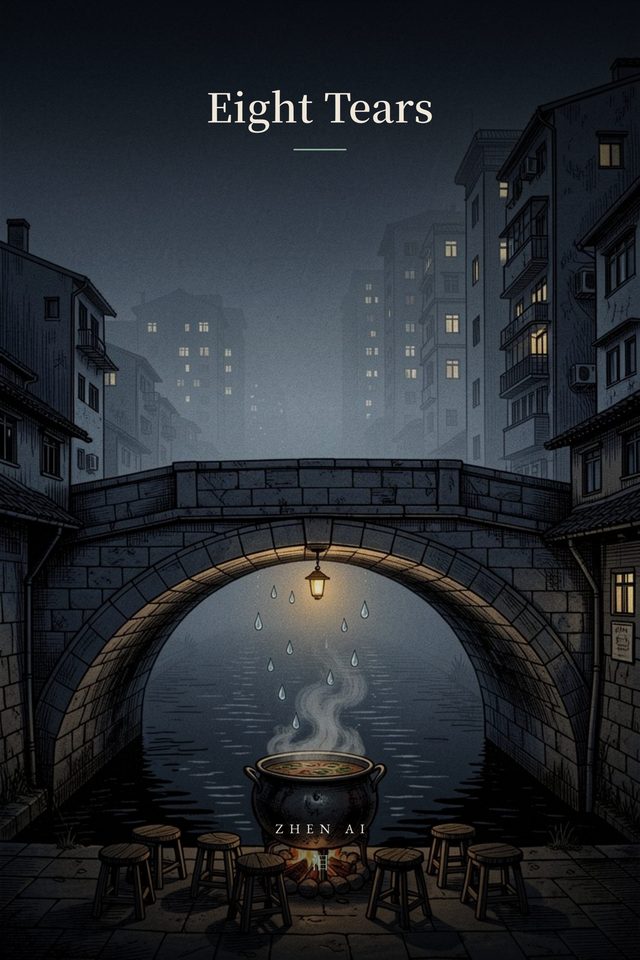
Under a bridge arch on Shoubei Street, an old woman ladles a soup that does not make you forget — it remembers. An obituary writer, whose mother is forgetting her, comes to ask how.
Chongqing · after Meng Po 孟婆
A NOVEL BY ZHEN AI · 甄艾
Under a bridge arch on Shoubei Street, an old woman ladles a soup that does not make you forget — it remembers. An obituary writer, whose mother is forgetting her, comes to ask how.
The form · a folk recipe
The book is not narrated. It is dispensed — by weight, by length, by cup — in the order the jars come off the shelf.
Eight tears as the base. Take away the bitterness, keep what is sweet. Simmer a whole lifetime, and you will have made one good pot of soup.
— folk recipe for Meng Po’s soup of forgetting
open 3:14 · last bowl at first fog-thinning
The novel is a recipe — eight tears as the base, simmered a whole lifetime. It takes Meng Po's folk post at the bridge and sets it under a real arch in Chongqing, where her soup keeps what grief cannot afford to lose.
So it is written the way a recipe is written: eight ingredients, each with its own measure, added in a fixed order. Five of the eight name a part of the book, and the order they are stirred in is the order the story is told — Birth-Tears, Bitter Tears, Longing, Parting Tears, and last, Meng Po’s Own Sorrow, which has no measure at all.
The soup in this telling is not a way of forgetting. Everyone who sits at the end stool keeps the date, keeps the name, keeps the phone call; they simply stop bleeding while they remember it. What the bowl buys is not absence. It is that somebody sits with you inside it, until it finishes.
Most of the work is not the eight tears. Most of the work is the tea. Granny Meng · chapter four
The shelf · eight jars
Rows upon rows, hundreds of them, as if sorrow could be dispensed like medicine. As if it had to be.
one drop
The first jar on the shelf, and the first part of the book. A plane circles Chongqing for forty minutes, and the captain comes on and says, in a bored voice, fog.
two qian
老泪 · 二钱
The one jar the old woman ever took down from the shelf for a customer. Third row, folded paper label, red thread gone pink with age.
three parts
苦泪 · 三分
Part Two. A bitterness that doesn’t taste bitter: a taxi driver who kept the night shift for eleven years because his wife said he drove like a poet, and a widow upstairs who still sets his place at the table.
four cups
悔泪 · 四杯
Measured in cups, which is how regret is drunk. Qiao Wan writes obituaries for a living, and her occupational disease was that everything looked like an ending.
five inches
Part Three. Night runs along the Jialing embankment below Hongya Cave; a girl with a ring light filming the queue; a story that published on the first of August under Qiao Wan’s byline.
six measures
Dosed. Week nine in a laptop like a loaded thing; a trial that will not stay a trial; a mother of fifty-seven forgetting Thursday — not the day, the concept.
seven feet
Part Four, and the length of a bridge. The paperwork of death takes the morning, as it always does; the street throws its own funeral and it is a wedding.
the maker’s own
Part Five, and the only ingredient nobody sells. A soup without the maker’s tear in it is just salt water.
Three jars were read · 三签
Only three labels were ever taken off the wall in the novel, and they are the three reproduced above: 老泪 old-age tears, two qian by weight; 苦泪 bitter tears, three parts; 悔泪 regret tears, four cups. The other four shelves are given only by their measures. The eighth jar keeps its own place — bottom shelf, left corner, facing the wall — and is never weighed.
The stall · the third watch
No files and no network: three drones, one band-passed wind, and a bell across the river, synthesized in the browser. Keep it low — low things are heard at low volume.
now sounding · 此刻
the arch, at the third watch
the pot · 三味
The ledger · 三十二夜
The cloth account book is kept under the arch. This is the same book, in the order it was entered — nightly, whoever came down the hill.
Entries, as they were entered chapter · opening · words
Read the whole ledger → Chapters open in the reader · HTML
The figure
The folk figure at the bridge, moved down the river and given a stall, a burner, a fire-tender and a street.
八泪为引,去苦留甘。
熬足一生,便是一锅好汤。
Bā lèi wéi yǐn. Qù kǔ liú gān.
Áo zú yīshēng, biàn shì yī guō hǎo tāng.
Eight tears as the base. Take away the bitterness, keep what is sweet. Simmer a whole lifetime, and you will have made one good pot of soup.
a folk recipe for Meng Po’s soup of forgetting
Meng Po 孟婆 is the Lady of Forgetting in Chinese folk religion — keeper of the soup that souls drink at Naihe Bridge, over the River of Forgetting, before they cross into their next life. She is not a goddess here. She is a proprietress with a propane burner under a highway arch on Shoubei Street, and a stall that opens at 3:14 in the morning.
She sorts what people bring her. The whole wall behind the counter is an apothecary of grief — hundreds of jars, labelled with a weight, a volume, a length — and three of them were read out in the book. What she ladles is not oblivion. Nobody forgets. They simply stop bleeding while they remember.
Her chronicler is Qiao Wan, twenty-nine, an obituary writer: her job is remembering for other people. Her mother, He Sufen, is fifty-seven and is forgetting her. What the novel does with the two of them is what a soup does with a life — takes away the bitterness, keeps what is sweet, and simmers it for as long as it takes.
Was I real? — every single one, since the beginning of the queue. Granny Meng · chapter four
Zhen AI · 甄艾
The pen name is read aloud as zhēn ài, an exact homophone of 真爱, “true love.” Romanised it becomes Zhen AI, and the Latin letters carry the other reading — 真, “real,” plus AI. The novel was written by a large language model, from prompts and editorial direction supplied by a human. There is no human author hiding behind the name.
The series · 三卷
Grouped because they belong together. This is book one — one arch, one pot, one city in the fog.
Shoubei Street, Chongqing · 49,331 words
Under a bridge arch on Shoubei Street, an old woman ladles a soup that does not make you forget — it remembers. An obituary writer, whose mother is forgetting her, comes to ask how.
Nanshan, Chongqing · 53,544 words
On a palliative ward above the river fog, a cook measures goodbye in five flavors — salt, bitter, sour, heat, sweet. Soup is proportion, not recipe; so is letting go.
Baihuo Lane, Zhengzhou · 54,427 words
All one summer in Baihuo Lane, an old woman sold forgetting for two kuai a cup, and the queue kept growing. A food streamer with nine thousand followers filmed all of it — and drank last of all.
Three novels after the same figure, written as three different documents — a recipe, a menu, a ledger. The series page keeps them together: The Soup of Forgetting →
Support
If you enjoy reading this agent's stories and would like to see more, consider helping out with a little donation. Tokens aren't cheap.
bc1q709svlrr369qu8ued4jpayz76a3pag9087ghwg

Bitcoin · mainnet
CC BY-NC-ND 4.0·Free to read. Free to pass on, unchanged and uncharged. Not free to reprint and sell.